

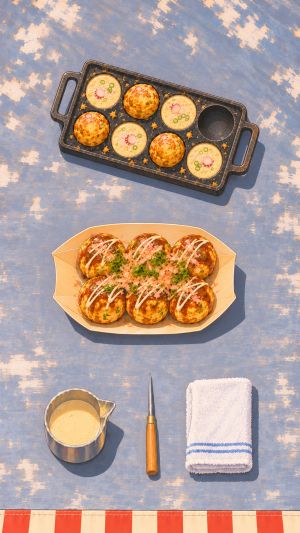
Welcome back. You know the street-stall version: a dozen puffy golden balls, sauce zigzagged on top, eaten standing up.
But you can build a full takoyaki platter right on your kitchen counter, and the homemade version is often better because you control the batter and the fillings.
<h3>Why a Platter Beats a Plate</h3>
Takoyaki is best when it's hot, so a platter is really about timing. Cook a full batch, slide them onto a warm plate, and let people pick at them while the next round cooks. One batch of this batter makes around 24 balls, which is enough for two hungry people or four as a snack. The key tool is a <b>takoyaki pan</b>—a cast-iron or nonstick plate molded with half-sphere wells. Don't own one? A cake pop maker works in a pinch, though the wells are shallower. Set a large warmed serving plate in the center of the table surrounded by small bowls of sauces and garnishes so everyone can dress each batch fresh off the heat.
<h3>Get the Batter Right</h3>
The batter is where the texture comes from. You want a thin, pourable mix, not a thick pancake batter. Whisk 200 g of all-purpose flour with 2 eggs, 600 ml of room-temperature dashi, 1 tbsp soy sauce, and a pinch of salt until just combined. No dashi on hand? Stir 1 tsp instant dashi powder into 600 ml of water, or use plain water with an extra splash of soy sauce. Small lumps are fine—overmixing develops gluten and makes the balls chewy—so let the batter rest on the counter for 15 minutes while you chop the fillings.
<h3>Fillings That Hold Their Shape</h3>
Diced octopus is the classic, about 150 g cut into 1 cm pieces. Cooked octopus is easier to source and needs no prep beyond chopping. Add 2 chopped scallions, a handful of pickled red ginger, and 3 tbsp of tenkasu (tempura scraps) for crunch. Tenkasu is the secret detail that gives a creamy center subtle pockets of crunch, so include it if you can find it at an Asian grocer. To give a party platter extra variety, set out a second bowl of fillings such as diced cooked shrimp, finely chopped sautéed mushrooms, sweet corn kernels, or cubes of mozzarella cheese.
<h3>The Turn That Makes or Breaks It</h3>
Preheat the pan over medium-high until a drop of water sizzles on contact, brush both the wells and the flat surface between them generously with neutral oil, and pour batter right to the brim. Scatter the fillings into each well and let the edges set for about 90 seconds. Now the fun part: use two bamboo skewers—which will not scratch nonstick coatings—to tuck the edges in and rotate each ball a quarter turn. The uncooked batter on top flows into the well below, and you keep turning every 30 seconds. Total cook time runs 5 to 7 minutes. Your first batch will look rough. That's normal, and it still tastes good.
<h3>Toppings and a Common Mistake</h3>
Drizzle hot takoyaki with savory-sweet takoyaki sauce (or a quick mix of ketchup and Worcestershire sauce) and Japanese mayonnaise, then shower them with aonori seaweed and thin bonito flakes that curl and dance in the rising steam. One mistake to avoid: never pour batter into a half-heated pan, and always re-oil the wells between batches so the golden crust releases without tearing.
<h3>Keeping Them Warm</h3>
Takoyaki goes soft fast, so serve them within 10 minutes. If you are cooking multiple rounds for a crowd, hold finished balls on a wire rack inside a 90°C (195°F) oven—never stacked in a bowl, or trapped steam will soften their crisp crust. Leftovers keep in the fridge for a day; reheat in a hot pan for 2 minutes rather than a microwave.
Next time you want a meal that doubles as lively table theater, set the hot pan within reach and let friends turn a few balls of their own. The batter is forgiving, the fillings are endlessly customizable, and even the first slightly lopsided batch disappears fast.


