

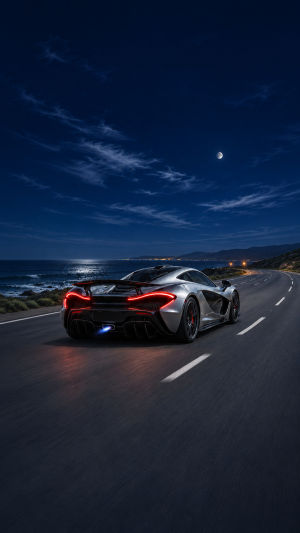
Hi, everyone. Most cars carry their engine up front, right over the wheels that steer.
A mid-engine sports car puts it behind the driver instead, and that single change reshapes how the whole car behaves. You feel it the moment you turn the wheel.
<h3>Where the mass actually sits</h3>
In a front-engine car, the heaviest part of the car sits ahead of you. In a mid-engine layout, the engine sits between the cabin and the rear axle, which pushes the bulk of the weight toward the center of the car. Porsche's 718 Cayman runs this layout, and the difference shows up in the numbers: the car's weight distribution lands close to an even split front to rear. Less mass up front means the front tires have less weight to fight when you ask them to turn.
<h3>Turning feels lighter and quicker</h3>
Here's the part you notice first on a back road. With the engine behind you, the front end carries less load, so it changes direction with less effort. The nose doesn't have to drag a heavy engine block around a corner. That's why a Lotus Emira, which uses a mid-mounted engine, feels so immediate when you steer into a bend. The front tires simply have less work to do.
<h3>Grip stays balanced through a corner</h3>
Mid-engine cars also hold their balance when you push harder. Because the weight sits near the middle, both axles share the load more evenly, and the rear tires, which carry the driving force, stay planted as you accelerate out of a turn. The Ferrari 296 GTB leans on this trait hard. Its engine sits low and central, so the car stays settled when you feed in power mid-corner instead of going light at the front.
<h3>The braking advantage is real</h3>
Braking is where the layout quietly wins again. With mass concentrated in the center, the car stays flatter under hard deceleration, and the rear tires keep more of their grip. That means you can brake later and carry more speed into a corner. On a car like the McLaren Artura, this shows up as stability under heavy stops, not just raw stopping power.
<h3>What you give up for the gain</h3>
It's not free. The engine sitting behind you eats into cabin and cargo space, which is why most mid-engine cars are two-seaters with a small front trunk. Access to the engine for service is tighter too, and the layout costs more to build. You trade practicality for the way the car drives, and for most buyers of these cars that's the whole point.
<h3>The layout rewards smooth inputs</h3>
One more thing worth knowing. A mid-engine car rotates easily around its center, which means it responds sharply to your inputs, good and bad. Jerky steering or a sudden lift of the throttle can unsettle the rear faster than in a front-engine car. Drive it smoothly and the balance works in your favor. The car rewards patience more than force.
So the next time you see a mid-engine sports car, remember it's not just about where the engine looks. It's about balance, and how a car with its weight near the middle turns, grips, and stops with less effort. If you ever get a chance to drive one, pay attention to that first corner. You'll feel the difference in your hands.


