

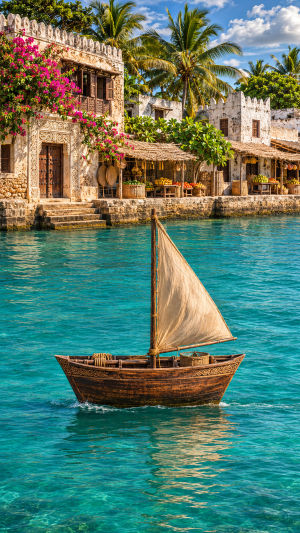
Traditional sailing boats cross the channel, poetry fills the evening air, and local musicians bring the waterfront to life during the Lamu Cultural Festival in Kenya. Held in the historic island settlements of Lamu Old Town and Shela, the annual gathering highlights the coastal traditions of the Lamu archipelago.
Its programme brings together maritime skills, traditional games, performing arts, handmade crafts, and local food, offering visitors a closer connection to the area's Swahili heritage.
<h3>Traditional Dhow Races Take Centre Stage</h3>
Sailing competitions are among the festival's main attractions. Traditional wooden dhows, including smaller mashua and larger jahazi boats, compete across the channel between Lamu and Manda Island. Their distinctive lateen sails make the races particularly recognisable, while crews work together to navigate the water and reach the finish near the waterfront or Shela.
The boats are closely connected to the area's maritime history. Dhows continue to be built by hand in the archipelago, with Matondoni village on the western side of Lamu Island known for its boatbuilding tradition. The races therefore offer more than a sporting spectacle: they also bring attention to the craftsmanship and sailing knowledge that have been passed between generations.
<h3>Water Activities and Traditional Games</h3>
The festival programme also includes swimming and canoe competitions, with young islanders taking part in races around the harbour and nearby beaches. These events add another dimension to the coastal programme and give local participants an opportunity to demonstrate their skills on the water.
Away from the channel, visitors can encounter bao tournaments in public squares and along the traditional stone benches known as barazas. Bao is a strategy game played on a four-row board using small pits and seeds. Players move quickly, making decisions that can change the direction of a match. The games often attract spectators who follow each move and discuss the players' decisions.
<h3>Swahili Poetry and Coastal Music</h3>
Poetry is another important feature of the Lamu Cultural Festival. Evening performances introduce audiences to shairi, a form of Swahili verse, as well as longer compositions known as utenzi. Some poems are created specifically for the festival, while others reflect literary traditions that have been part of coastal life for generations.
Music performances add to the evening atmosphere. Taarab combines sung poetry with string instruments and percussion, while traditional ngoma drumming brings energetic rhythms to the programme. Together, the performances highlight the relationship between language, music, and storytelling in Swahili culture.
For visitors, the evening events offer a different experience from the daytime sailing competitions. They provide an opportunity to appreciate the region's artistic traditions through live performances rather than simply viewing historical buildings or coastal scenery.
<h3>Handicrafts, Henna, and Local Food</h3>
Stalls around the main square and the fort provide space for local craftspeople and food vendors. Visitors can encounter henna painting, carved wooden doors and furniture, embroidered kofia caps, and other handmade products associated with the Lamu archipelago.
Traditional Swahili dishes are also part of the festival experience. Food stalls allow visitors to sample coastal cooking while spending time around the main gathering areas. The combination of crafts and food gives the event a strong community atmosphere and creates opportunities for local makers and vendors to present their work.
The programme changes from one edition to another, and organisers generally release the detailed schedule closer to the event. Visitors should therefore check announcements from Lamu County and local organisers before arranging their activities.
<h3>Planning a Visit to Lamu</h3>
The festival usually takes place over approximately three days in late November, although the exact dates are not fixed. Because the schedule can change from year to year, travellers are advised to confirm the latest announcement before booking transport and accommodation.
Visitors generally reach the island by flying to Manda Island. Scheduled flights operate from Nairobi, while connections from Mombasa and Malindi may also be available depending on the season. From the airstrip, a short boat journey takes travellers across the channel to Lamu Old Town or Shela.
With very few cars on the island, walking and boat travel are common ways to get around. Lamu Old Town's narrow lanes are best experienced on foot, while boats provide convenient connections to Shela and other coastal locations.
The Lamu Cultural Festival offers a varied presentation of coastal heritage, bringing together sailing competitions, traditional games, poetry, music, crafts, and regional food. Its strongest appeal lies in the participation of local communities, whose skills and creative traditions give the gathering its character.
For travellers, attending the event can also be an opportunity to spend more time on Lamu Island. Combining the festival with visits to the Old Town, Shela, and Matondoni creates a fuller experience of the archipelago and its distinctive Swahili culture.


