

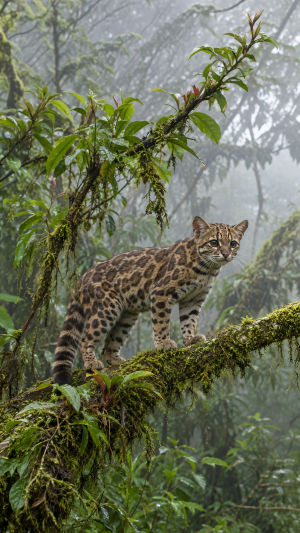
A small, spotted wild cat from Bolivia has given scientists a remarkable reason to take another look at the feline family tree. Named Leopardus tilcayo, this little-known species is smaller than an ordinary house cat and has a distinctive coat covered in irregular dark patterns.
Although local communities were already familiar with the animal, its identity as a separate species was only confirmed through genetic research. The finding, published in September 2026, marks the first time in more than a century that scientists have described a completely new living cat species.
<h3>Meet the Tilcayo</h3>
The tilcayo lives in Bolivia's Yungas, a mountainous cloud-forest region along the eastern slopes of the Andes. This environment is known for its humid conditions and forests frequently covered by low clouds.
The cat weighs approximately three to four pounds, making it noticeably smaller than most domestic cats. Its light brown fur is decorated with large, uneven rosettes, giving it a spotted appearance. It also has rounded ears, a relatively small face and a distinctive tail. Its scientific name, Leopardus tilcayo, comes from the name used by people in the local community. Researchers chose to retain that familiar name rather than introduce an entirely different one.
<h3>How Scientists Recognized a New Species</h3>
The story began around 2016, when a local resident found a small cat near a forest road outside La Paz, Bolivia. The animal was initially mistaken for a domestic kitten. It eventually arrived at Senda Verde Wildlife Sanctuary, where biologist Paola Nogales-Ascarrunz first examined it.
Nogales-Ascarrunz, founder of the Bolivian Felids Research Program, initially considered whether the animal might be a northern tiger cat, a species with a similar appearance. However, several physical features did not fit the expected description. Its body size, unusually large rosettes and tail proportions raised questions about its classification. Rather than relying only on appearance, researchers turned to genetic evidence to investigate its identity.
The team compared genetic information from 38 individuals belonging to the Leopardus group. Their analysis showed that the unusual Bolivian cat represented a distinct evolutionary lineage. The results confirmed that it was not simply an unusual example of an already recognized species.
<h3>A New Branch in the Feline Family Tree</h3>
The findings also changed scientists' understanding of South America's tiger cats. Animals in this group can look remarkably similar, making it difficult to distinguish their species through physical features alone. The genetic analysis identified five distinct tiger cat species: the northern tiger cat, southern tiger cat, clouded tiger cat, eastern tiger cat and the newly named tilcayo.
Researchers also identified a previously unrecognized subspecies of northern tiger cat in Peru, named Leopardus tigrinus antisuyo. The study suggests that the tilcayo's evolutionary lineage separated from related tiger cats approximately 1.4 million years ago. During the Early Pleistocene, changing climate conditions affected the distribution of forests across South America.
<h3>What Scientists Still Need to Learn</h3>
Despite confirming its scientific identity, researchers have limited information about the tilcayo's everyday life. Its population size, complete geographic range, diet and behavior remain uncertain. Available evidence offers a few early clues. Camera footage suggests the cat may be more active at night, while biological samples provide preliminary information about its feeding habits. However, these observations are not enough to establish a complete picture of its lifestyle.
Researchers will need further observations and genetic information to understand how widely the species is distributed and how its population is doing. This information is particularly important because recognizing separate species can change how scientists assess biodiversity.
For researchers, the tilcayo is both a new addition to the feline family tree and an invitation to learn more. Its small size may make it easy to overlook, but its discovery has opened up fresh questions about the diversity and evolutionary history of South America's wild cats.


