

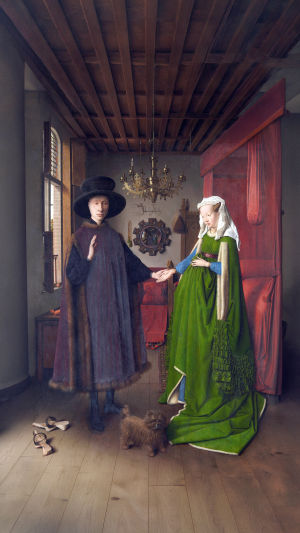
One of the most recognisable paintings at London's National Gallery may not show the people historians have associated with it for generations. Jan van Eyck's Arnolfini Portrait, completed in 1434, has attracted questions about the identity of its subjects, the meaning of its setting and the occasion it was created to record.
Now, a new interpretation presented in a catalogue for an upcoming exhibition suggests that the familiar couple could actually be the artist and his wife. The proposal has reopened a debate that has never been completely settled.
<h3>A Painting Full of Unanswered Questions</h3>
Van Eyck's Arnolfini Portrait has been part of the National Gallery's collection since 1842. It depicts a man and a woman standing together inside a carefully detailed room. An inscription on the painting includes the artist's name and the year 1434, providing one of the few details that scholars can establish with confidence.
Beyond that, much remains uncertain. Researchers have debated who the figures represent, what event the painting might commemorate and whether the room reflects an actual interior or an imagined setting. The man's traditional association with the Arnolfini family comes from historical references connecting the painting to wealthy merchants from Lucca who were active in Bruges during the 15th century.
<h3>A Different Identity Proposed</h3>
The latest interpretation comes from Stephan Kemperdick, a curator at Berlin's Gemäldegalerie. In an essay written for the catalogue accompanying the National Gallery exhibition Van Eyck: The Portraits, he suggests that the man could be Jan van Eyck himself. The woman beside him, he argues, may be Margaret, the artist's wife, who appears in another portrait painted by Van Eyck in 1439.
Kemperdick's suggestion is not entirely new. During the late 1840s, Charles Eastlake, who later became the National Gallery's first director, also considered the possibility that the painting represented Van Eyck and his wife. Eastlake focused on the Latin inscription, interpreting it as a statement that the artist had been present in the scene. He believed the wording could connect Van Eyck directly to the male figure.
The idea eventually lost support after art historian W. H. James Weale offered a different interpretation in the early 1860s. He connected a reference in a 16th-century inventory to the Arnolfini family, establishing an identification that became widely accepted.
<h3>Looking Again at the Inscription</h3>
Kemperdick has returned to the inscription as an important piece of evidence. Its unusually prominent position, close to the man's head, may suggest a direct relationship between the artist and the person portrayed. He also questions the historical reference used to identify the sitter as an Arnolfini. In his interpretation, the name recorded in the inventory may not have been the man's actual surname. Instead, it could have been a later mocking label that encouraged generations of viewers to associate the figure with the wrong family.
<h3>Why Other Experts Remain Cautious</h3>
The proposal has attracted interest, but not all specialists are convinced. Nicholas Flory, co-curator of the National Gallery exhibition alongside Emma Capron, describes the interpretation as intriguing but speculative. One difficulty concerns the appearance of the two women. Margaret's identity in the 1439 portrait is supported by its inscription, but her eyes appear greyish-blue. The woman in the Arnolfini Portrait has brown eyes.
Art historian Till-Holger Borchert also remains unconvinced. He considers the historical inventory reference a strong indication that the painting is connected to the Arnolfini family. Maximiliaan Martens of Ghent University shares that view, seeing little reason to reject the traditional interpretation of the record.
<h3>The Theory Could Affect Other Portraits</h3>
Kemperdick's proposal has implications beyond the identity of the couple. The National Gallery has another Van Eyck portrait, dated 1433, which it tentatively presents as a self-portrait of the artist. If the man in the Arnolfini Portrait is Van Eyck, that earlier identification would need to be reconsidered.
The debate is also reflected in the way other works are presented. The Berlin Gemäldegalerie has recently renamed its portrait of the man who appears in the Arnolfini Portrait as Portrait of a Man with a Red Chaperon. The National Gallery exhibition, however, will retain the older association with the Arnolfini family.
The identity of the couple is only one of several unresolved questions surrounding Van Eyck's celebrated painting. Kemperdick's interpretation may not settle the mystery, but it gives viewers another way to approach a familiar masterpiece. For now, the painting remains open to debate, reminding us that even works studied for ce
Kemperdick's interpretation may not settle the mystery, but it gives viewers another way to approach a familiar masterpiece. For now, the painting remains open to debate, reminding us that even works studied for ce


